Years of study and still can't speak? 5 causes and how to fix them
Why do years of grammar and vocabulary still leave you afraid to speak? Five research-backed causes and how to fix each one, from fear of mistakes to forgetting what you learned.
Many people study English, or another language, for ten years at school and university. They can do hard grammar exercises and read technical documents, yet freeze when they meet a native speaker. That is not because they “have no talent”. The five causes below have all been studied, and all of them can be fixed.
1. You listen and read a lot, but speak far too little
Listening and reading help you understand. Speaking helps you retrieve the right sentence when you need it. The linguist Merrill Swain called this the role of output: when you have to speak, you notice which words and structures you are missing, and your brain has to process the language more deeply than when you only listen.
In a 90-minute class of 30 people, each person usually speaks for a few minutes at most. Over a year of classes like that, the total time you actually spend speaking may be just a few hours.
The fix: measure your learning in minutes spent speaking each day, not lessons completed. A sensible starting goal is 5 minutes of speaking a day, every day. It is also the main measure MOMIC tracks for each learner.
2. You are afraid of making mistakes in front of others
Foreign language anxiety is a well-measured phenomenon. The well-known study by Horwitz, Horwitz and Cope (1986) describes the tension and fear of being judged that make learners freeze even when they know the answer. The feeling is strongest when speaking in front of a group.
The fix:
- Start with a “safe” partner: a tutor who doesn't judge, or a friend at your level.
- Make mistakes without anyone else seeing the corrections. In MOMIC, corrections only appear on your own screen.
- Raise the stakes gradually: AI tutor → role-play characters → real people in group rooms. And only talk to strangers when you agree to.
3. You forget what you learn, because you review the wrong way
Re-reading a word list feels like remembering, but very little sticks. A much more effective method is testing yourself: trying to recall the right sentence before looking at the answer.
In an experiment by Karpicke and Roediger (Purdue University, published in Science in 2008), students learned Swahili–English word pairs. The group that kept being tested on every word, including the ones they already knew, remembered about 80% a week later. The group that dropped learned words from later tests remembered only 33–36%.
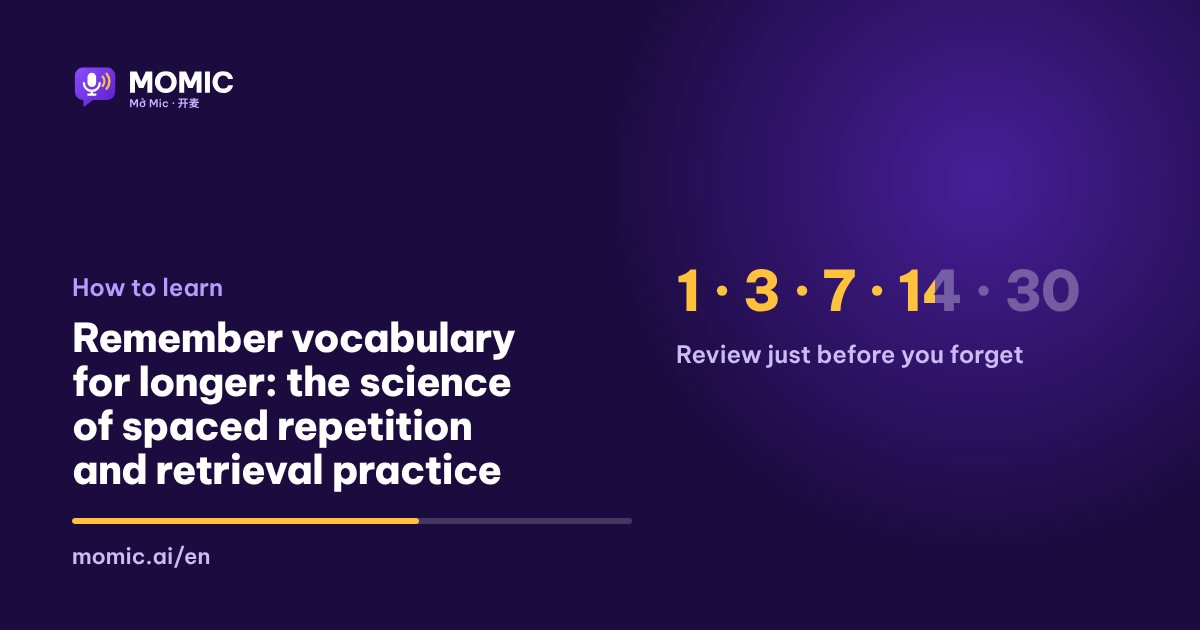
Combine this with spaced repetition (reviewing just before you forget, at growing intervals) and the effect is even clearer. A review by Cepeda and colleagues (2006) of hundreds of studies found that spreading practice out beats cramming it into one session.
The fix: every sentence you once got wrong should come back after 1, 3, 7, 14 and 30 days, and each time you should say it again, not just read it. Read more in our article on spaced repetition and retrieval practice.
4. You are corrected at the wrong moment
Being interrupted mid-sentence to fix an error breaks your flow and makes you reluctant to continue. But never being corrected lets the same errors repeat forever.
The fix: finish what you want to say, then correct the sentence you just said, briefly and with a reason. Focus on one or two of the most important errors at a time. That is how MOMIC tutors are designed: they reply to you first, like a normal conversation, and only then show the correction card.
5. You learn model sentences that aren't tied to real situations
“How are you? I'm fine, thank you, and you?” is a sentence everyone knows and almost no one uses. When the sentences you learn aren't tied to situations you will face, your brain doesn't know when to bring them out.
The fix: learn by what you need to do: order a drink, check in at the airport, report progress, answer an interview question, report a product defect to a partner. Each situation has a few concrete tasks to complete by speaking. When you meet the situation in real life, the sentences come by themselves.
A 15-minute daily plan
- 3 minutes: review 5 sentences from your notebook by saying them again.
- 8 minutes: role-play a situation at your level and try to complete its tasks.
- 4 minutes: repeat 3 new model sentences out loud, and record yourself if you can.
Do it every day for 30 days and you will have spoken more than in years of classroom study.
Sources
- Karpicke, J. D., & Roediger, H. L. (2008). The critical importance of retrieval for learning. Science. Summary by Purdue University.
- Cepeda, N. J., et al. (2006). Distributed practice in verbal recall tasks: A review and quantitative synthesis. Psychological Bulletin, 132(3).
- Horwitz, E. K., Horwitz, M. B., & Cope, J. (1986). Foreign Language Classroom Anxiety. The Modern Language Journal, 70(2).
- Swain, M. (1985). Communicative competence: Some roles of comprehensible input and comprehensible output in its development.